Henry and Grace’s final separation
Our Chemical HeartsHenry and Grace’s final separation turns on a distinction neither can undo: Henry loves Grace, but she remains bound to Dom and to the grief that has shaped her since childhood. Their parting does not resolve those feelings into a neat ending. Instead, it leaves each to continue separately, with the relationship’s daily ties gone and love persisting at a distance.
Background and the truth about Dom
The separation is preceded by Grace explaining what Henry had never fully understood about her past. When he tells her that people had worried about her, she recounts being placed on suicide watch during the first month after Dom died. Others had watched her for signs that she might harm herself; in her view, Dom alone had known her. Henry recognizes that he, too, had feared she was dead when she disappeared, and that his fear had placed him among the people who did not understand her as Dom had. Grace insists that she is not depressed but angry, then decides to tell Henry about Dom because she believes he deserves the truth.
Her account begins when she was nine. Her father was dead, her mother had been away for three days, and the food at home had run out. Her uncle collected her and left her with his colleague Mary, whose son was about her age. Grace remembered distrusting boys, but at Mary’s house she saw Dom jumping on a trampoline. He invited her to play Mario Kart, patiently taught her a game she had never seen before, and let her win. They later held hands in his tree house while watching cartoons on a laptop. Grace says that the day became one of the best of her childhood: she loved Dom and his family, and by that evening had decided she would marry him. The memory locates their bond in a moment of welcome and care, not merely in the later tragedy that Henry had been trying to understand.
Releasing Dom and confronting loss
At the abandoned train station, Grace carries a small metal box containing objects from Dom’s shrine: the anchor necklace she wore when Henry first saw her, a Strokes keychain, and Dom’s unwashed Ramones shirt. She takes Henry’s hand and leads him into the pond, where her limp is barely visible in the water. Together they release the keepsakes one by one. Last to sink is the box, marked DOM GRADE 10, settling among the debris as fish move around it. The physical act gives shape to a release that remains emotionally uncertain. Henry wonders whether Grace has reached redemption or forgiven herself; she answers, “Stories with happy endings are just stories that haven’t finished yet.”
Her gestures do not amount to a declaration that grief is over. Grace leaves the station in Henry’s jacket and her damp white dress, then, once they reach his car, strips to her underwear in the street and throws the dress into the gutter. The scene connects the intimate ceremony of letting go with the abrupt, exposed movement that follows it. Henry can witness what she chooses to release, but he cannot determine what that release means or make it a promise about their future.
The final parting
In their last exchange, Grace tells Henry, “You’re an extraordinary collection of atoms, Henry Page,” smiling and laughing softly before her expression fades. She stands and leaves again. Henry understands the departure not as the loss of a single, settled image but as the end of his claim on a many-sided person. He names the versions he had loved: the living Grace, still wearing Dom’s clothes and sleeping in his sheets, who ran on an injured leg so it would not heal too quickly; the Grace preserved in photographs and half-remembered fantasies; and the imagined, repaired figure he associates with Kintsukuroi, dressed in floral clothes and dancing with him beneath string lights. He recognizes that the last of these was partly a figure he helped create, rather than the whole of Grace. His phrase for this accumulated understanding is that he loved “a multiverse of Graces.”
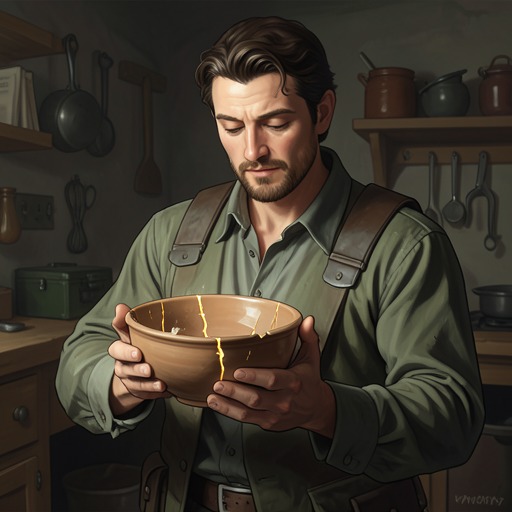
Grace’s contribution to the Westland Post makes the separation tangible in another form. Henry opens a sheet of paper torn into pieces and reassembled with clear tape on the back. Gold ink traces the jagged lines across it, turning the damage into a visible pattern of repair. The title, “I do not love you,” has been circled in gold. Henry expects the title to hurt, but it does not in the way he anticipates; he reads the piece once more, for the last time. Its repaired surface echoes his realization that neither affection nor repair can erase the difference between loving Grace and being loved by her in the way he wants.
Aftermath and significance
The wound does not close at once. A week later, Grace is no longer Henry’s first thought when he wakes, but his second; he notices that the feeling no longer strikes through him like lightning and describes the wound as beginning to heal. The small change becomes evidence that he can survive the separation, not evidence that he has forgotten her.
After Christmas, Grace’s limp becomes less noticeable, she stops using her cane, and she begins driving to school. She still sometimes wears an item of Dom’s clothing, but increasingly wears her own. At the same time, Henry and Grace remove one another from Facebook, Instagram, and Snapchat. They transfer custody of Ricky Martin Knupps II to Ryan, who renames him Fish Fish and loves him. These ordinary acts—unfollowing, transferring responsibility, returning to separate routines—complete the practical severing that the farewell itself could not accomplish.
The emotional separation remains incomplete in a different sense. Henry remembers Grace at particular moments, including New Year’s Eve, movies watched alone, and especially mornings when she is not there. The story makes room for both recovery and continuing attachment: Henry’s life can move forward while longing returns, and Grace’s love for Dom remains alongside the history she shared with Henry. Their final separation is therefore not a reconciliation or a triumphant cure. It is the acceptance of distinct lives, bound by what they felt but no longer joined by daily contact. Henry’s closing understanding is starkly mutual and unequal: he continues to love Grace, just as she continues to love Dom, privately and beyond the relationship they could have made together.